
Networking
Overview
IronCore's virtual networking architecture provides an end-to-end virtual networking solution for provisioned Machines running in data centers, regardless they are bare metal machines or virtual machines. It is designed to enable robust, flexible and performing networking control plane and data plane.
- Robust: IronCore's virtual networking control plane is mainly implemented using Kubernetes controller model. Thus, it is able to survive component's failure and recover the running states by retrieving the desired networking configuration.
- Flexible: Thanks to the modular and layered architecture design, IronCore's virtual networking solution allows developers to implement and interchange components from the most top-level data center management system built upon defined IronCore APIs, to lowest-level packet processing engines depending on the used hardware.
- Performing: The data plane of IronCore's virtual networking solution is built with the packet processing framework DPDK, and currently utilizes the hardware offloading features of Nvidia's Mellanox SmartNic serials to speedup packet processing. With the DPDK's run-to-completion model, IronCore's networking data plane can achieve high performance even in the environment where hardware offloading capability is limited or disabled.
IronCore's virtual networking architecture is illustrated with the following figure. It consists of several components that work together to ensure network out and inbound connectivity and isolation for Machine instances.
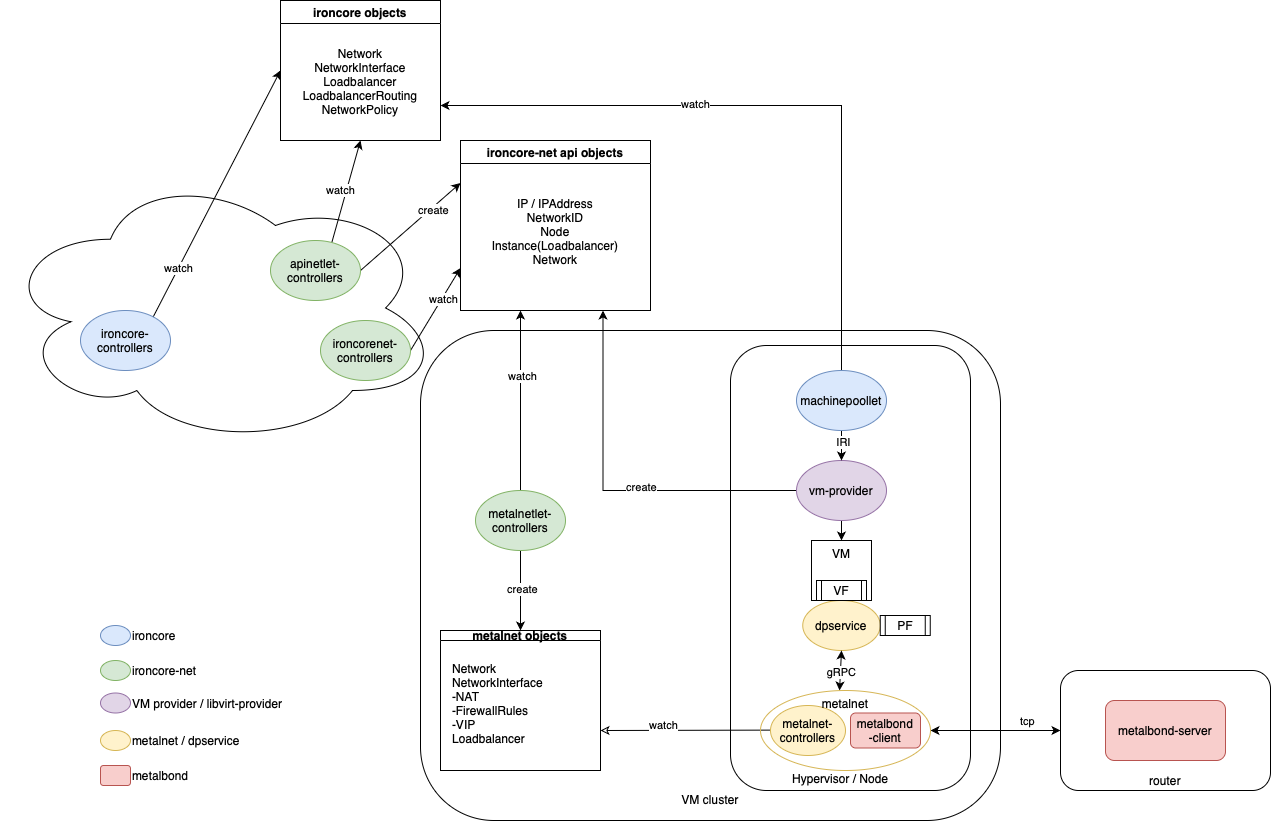
The main elements involved in IronCore's networking are:
- ironcore: Core networking component that manages network resources and configurations. For more details, see the Networking usage guide.
- ironcore-net: Global coordination service that manages network resource in an IronCore instance.
- metalnet: A service that provides cluster-level networking capabilities for
Machines. - dpservice: A service that manages data plane operations, including network traffic routing and policies.
- metalbond: A component that handles route announcements in an IronCore instance, ensuring that networking routes are correctly propagated across the IronCore installation.
ironcore and ironcore-net
The ironcore-net service is a global coordination service within an IronCore installation. Therefore, it is a single instance and the place where all network-related decisions like reservation of unique IP addresses, allocation of unique network IDs, etc. are made.
The ironcore-net service has, apart from its own API, two main components:
- apinetlet: This component is responsible for translating the user-facing API objects from the
networkingresource group into the internal representation used byironcore-net. - metalnetlet: This component is interfacing with the
metalnetAPI to manage cluster-level networking resources likeNetworkInterfacewhich are requested globally in theironcore-netAPI but are implemented bymetalneton a hypervisor level.
Example apinetlet flow
When a user creates a VirtualIP resource in IronCore:
apiVersion: networking.ironcore.dev/v1alpha1
kind: VirtualIP
metadata:
  name: virtualip-sample
spec:
  type: Public
  ipFamily: IPv4
The apinetlet will reconcile this VirtualIP by performing the following steps:
- Create an
IPobject in theironcore-netAPI, which reserves a unique IP address. - Update the
VirtualIPstatus with the allocated IP address.
The IronCore API server is agnostic on how the underlying global IP address is allocated and delegates this responsibility to ironcore-net.
A similar flow happens for Network, LoadBalancer and NatGateway resources, where the apinetlet is responsible for translating and allocating the necessary resources in ironcore-net to ensure that the networking requirements are met.
metalnetlet and metalnet
The metalnetlet and metalnet components work together to provide the necessary networking capabilities for Machines in an IronCore instance on a hypervisor host. In a compute cluster, the metalnetlet will create for each Node in the cluster a corresponding Node object in the ironcore-net API. This Node object represents the hypervisor host and is used to manage the networking resources which should be available on this host.
The image below illustrates the relationship between metalnetlet and metalnet:
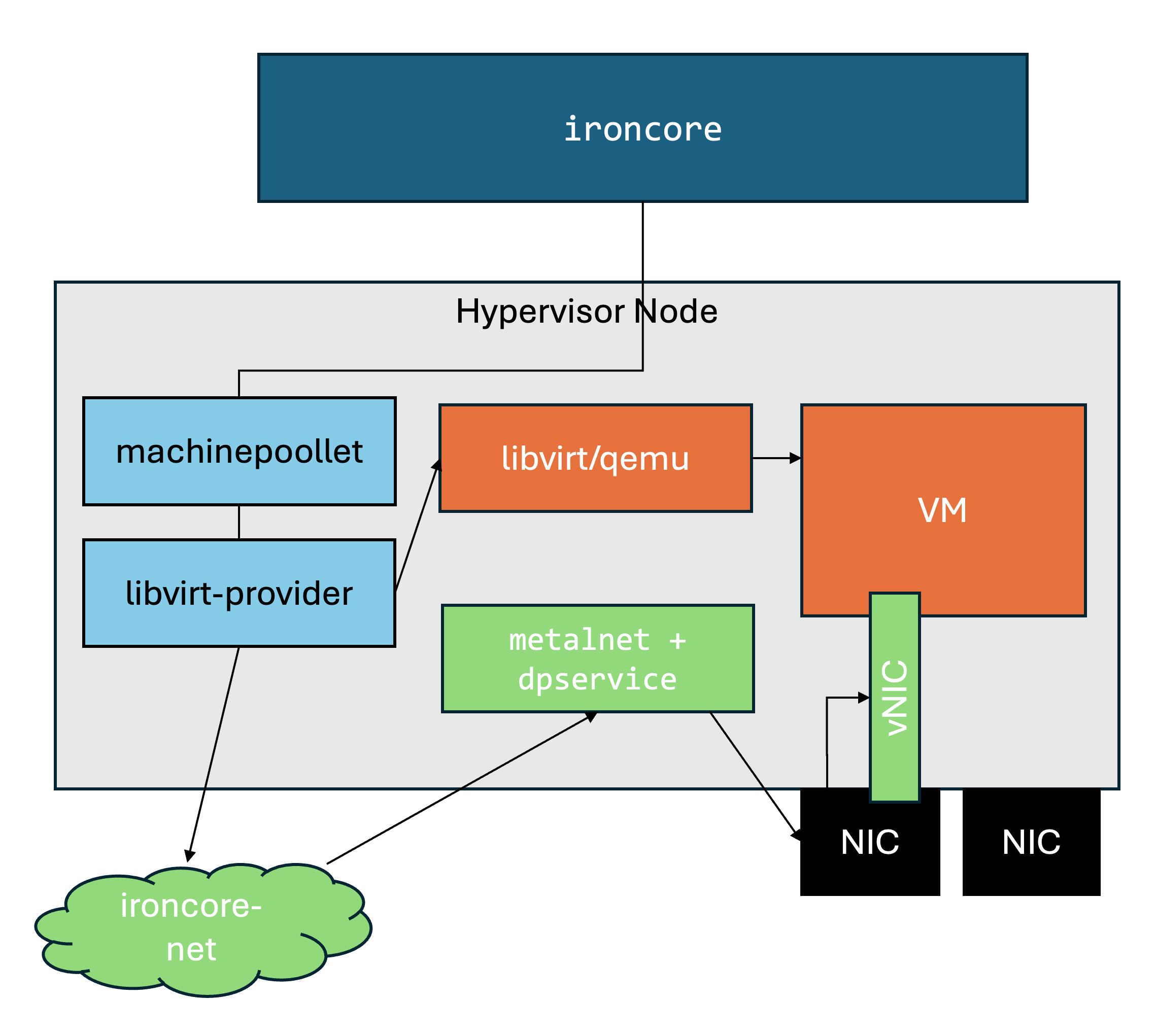
The NetworkInterface creation flow will look like this:
- A provider (in this case
libvirt-provider) will create a virtual machine against the libvirt daemon on a hypervisor host. In case aNetworkInterfaceshould be attached to this virtual machine, themachinepoolletwill call the correspondingAttachNetworkInterfacemethod on theMachineRuntimeinterface implemented by thelibvirt-provider. Thelibvirt-provideritself then has a plugin into theironcore-netAPI to create aNetworkInterfaceresource in theironcore-netAPI. - The
metalnetletwill then watch for changes to theNetworkInterfaceresource and create the correspondingNetworkInterfaceobject in themetalnetAPI using theNodeNameof the hypervisor host where the virtual machine is running. - Once
metalnethas created the virtual network interface on the hypervisor host, it will propagate the PCI address of this virtual network interface back to theironcore-netAPI by updating the status of theNetworkInterfaceresource. - The
libvirt-providerwill poll theironcore-netAPI to get the updated status of theNetworkInterfaceand will use the PCI address in the status to attach the virtual network interface to the virtual machine instance.
LoadBalancer and NATGateway resources follow a similar flow. Here, however, the compute provider is not involved. The apinetlet translates the IronCore LoadBalancer or NATGateway resource into the corresponding ironcore-net objects. Those are scheduled on ironcore-net Nodes. Once this is done, the metalnetlet watches those resources and creates the corresponding LoadBalancer or NATGateway objects in the metalnet API.
metalnet, dpservice and metalbond
As mentioned above, metalnet is responsible for cluster-level networking capabilities. It provides the necessary API to manage Networks, NetworkInterfaces, and other networking resources that are required for Machines on a hypervisor host. dpservice receives configurations, such as an activated interface with configured IP address or networking policies, via gRPC interfaces from metalnet. Meanwhile, metalbond is responsible for distributing encapsulation routes among instances of metalnet.
The following figure depicts the basic working flow of creating two interfaces for the same virtual private network.
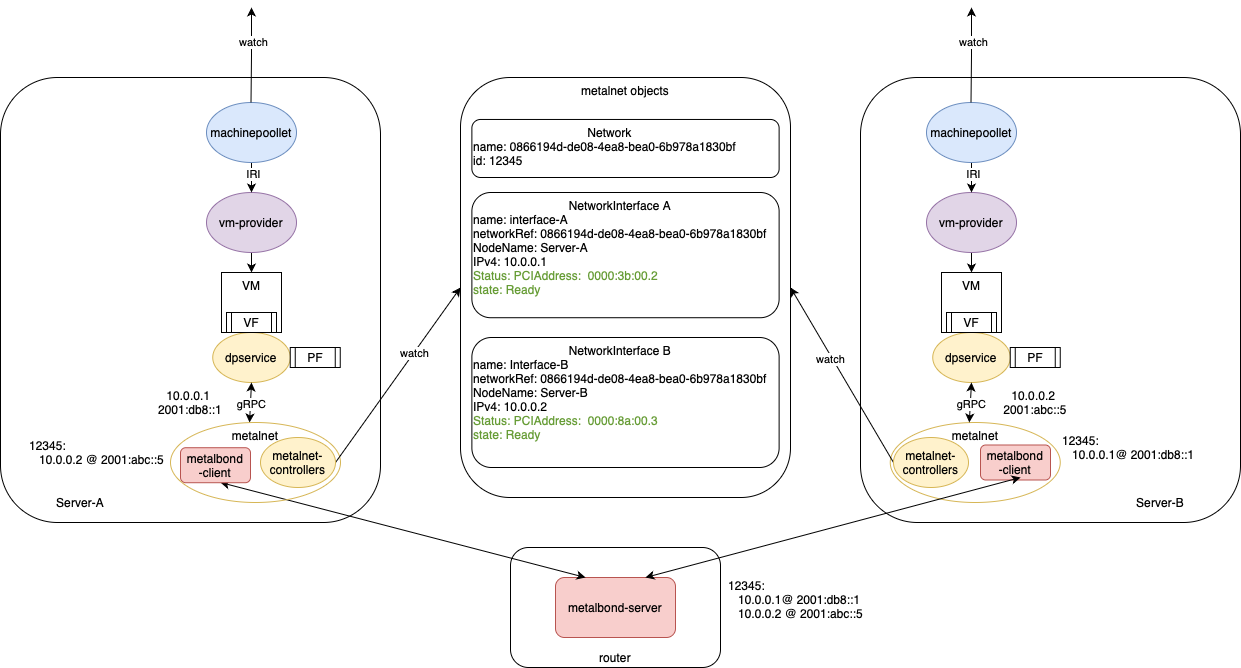
The metalnet controllers watch the metalnet objects such as Network and NetworkInterface. Upon arrival of a new NetworkInterface, metalnet communicates with dpservice to obtain a newly generated underlying IPv6 address for a corresponding interface's overlay IP address. For example, on Server-A, metalnet obtains an underlying IPv6 address, 2001:db8::1, for interface-A with a private IP 10.0.0.1. This encapsulation routing information is announced by the embedded metalbond-client to metalbond-server running on a region router, and further synchronized by other metalbond instances. For instance, metalbond on Server-B receives this 10.0.0.1@2001:db8::1 information and pushes it into its local dpservice via gRPC. The dpservice uses this routing information to perform overlay packet encapsulation and decapsulation to achieve communication among VMs running on different servers. Meanwhile, metalnet also picks a PCI address of a VF, such as 0000:3b:00.2, and attaches it as part of the NetworkInterface status, which is further used by ironcore-net and libvirt-provider to create a VM.